Stories
The crafts, and the people and places behind them
Every piece in the shop comes from a tradition older than any of us, and from people who still practise it. These are their crafts and where they come from. Maker profiles grow as we photograph and interview each workshop.
Istalif, Kabul province
The turquoise potters of Istalif
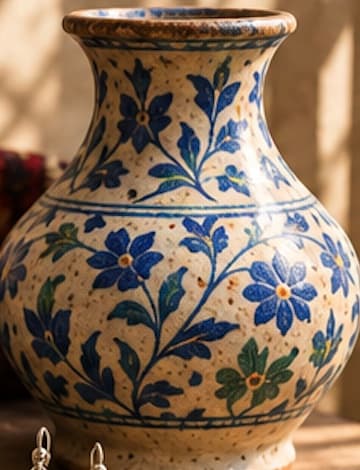
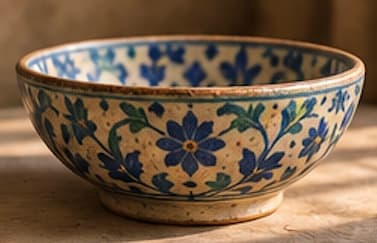
Istalif sits in the foothills north of Kabul, and clay has been thrown and glazed there for generations. The village is known for a glowing turquoise-green glaze made with ash from the ishkar plant, a colour travellers have written about for centuries.
Every bowl, plate and pitcher is thrown on a wheel, dried in the sun, glazed by hand and fired in a wood kiln. Because the kiln is never quite the same twice, no two pieces are quite the same shade, which is exactly the point.
The makers
From this tradition

Kandahar
Khamak, the needlework of Kandahar
Khamak is Kandahar’s signature embroidery: tiny counted stitches in silk thread on fine cotton, building up diamonds, stars and lattices that are often white on white. It decorates collars, shawls, scarves and the fronts of men’s shirts.
It is worked by women, usually at home, and sold through family networks. A single collar can take weeks of close work, and the finest pieces are kept for weddings and passed down.
The makers
From this tradition

Herat
Herat: silk, blue glass and saffron
Herat has been a city of craft since the Timurid era, when its tilework, calligraphy and miniature painting set the standard for the region. Silk is still reeled and woven there on wooden looms, and a few families still blow glass in deep blues and greens, melting recycled glass in wood-fired furnaces.
In the last two decades the plain around the city has also become one of the world’s notable saffron-growing regions. The crocus blooms for a few weeks each autumn and is picked by hand at dawn, much of that work done by women.
From this tradition


Sar-i Sang, Badakhshan
Lapis lazuli from Badakhshan
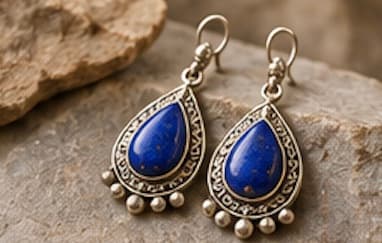
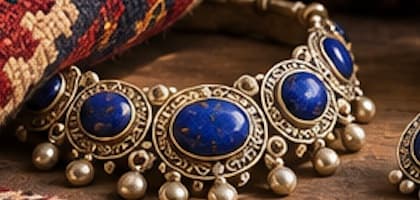
The lapis mines of Badakhshan, high in the northeast, have been worked for more than six thousand years. Their deep blue stone travelled to ancient Egypt and Mesopotamia, and ground into ultramarine pigment it coloured the skies and robes of Renaissance paintings.
Today the stone is cut, polished and set by jewelers in Kabul. Good lapis is an intense ultramarine flecked with golden pyrite, and the Badakhshan stone is still the standard the rest of the world is measured against.
The makers
From this tradition

Nuristan
The wood carvers of Nuristan
In the steep, forested valleys of Nuristan, carvers work walnut and cedar into chairs, doors, columns, boxes and frames covered in deep, interlocking geometric relief. The style is unlike anything else in the country and much older than the region’s modern name.
The work is done with chisels and mallets, not machines, and finished with oil so the grain shows through the pattern.
The makers
From this tradition

Maimana, Faryab, and the Turkmen north
Carpets and kilims of the north
Afghanistan is one of the world’s great weaving countries. Turkmen weavers in the north knot carpets around the gul, an octagonal medallion that tells you which tribe made it. Maimana is known for kilims, flat-woven rugs in bold bands of pomegranate red, indigo and saffron.
The wool is hand-spun, the dyes are largely from plants and minerals, and the looms are often set up at home, so a rug is a family’s work over months.
From this tradition


Parwan, Kandahar, Paktia, Badghis
Orchards, drying houses and nut forests
Afghan dried fruit was traded along the Silk Road for centuries, and it is still the country’s best-known export. Green kishmish raisins dry slowly in the shade of mud-brick drying houses; mulberries, apricots and figs dry on rooftops in the sun.
Pine nuts are gathered from the high forests of Paktia and Khost, wild pistachios from the forests of Badghis and Samangan, almonds from small orchards across the country. Every bag bought here reaches a farming family.
The makers
From this tradition


Work with us
Do you make something in Afghanistan?
We are always looking for more artisans and farmers to work with. Send us a message with photos of what you make and where you are.